Frankenstein by Mary Shelley
This blog task is assigned by Megha Trivedi Ma'am(Department of English, MKBU).

Publication:
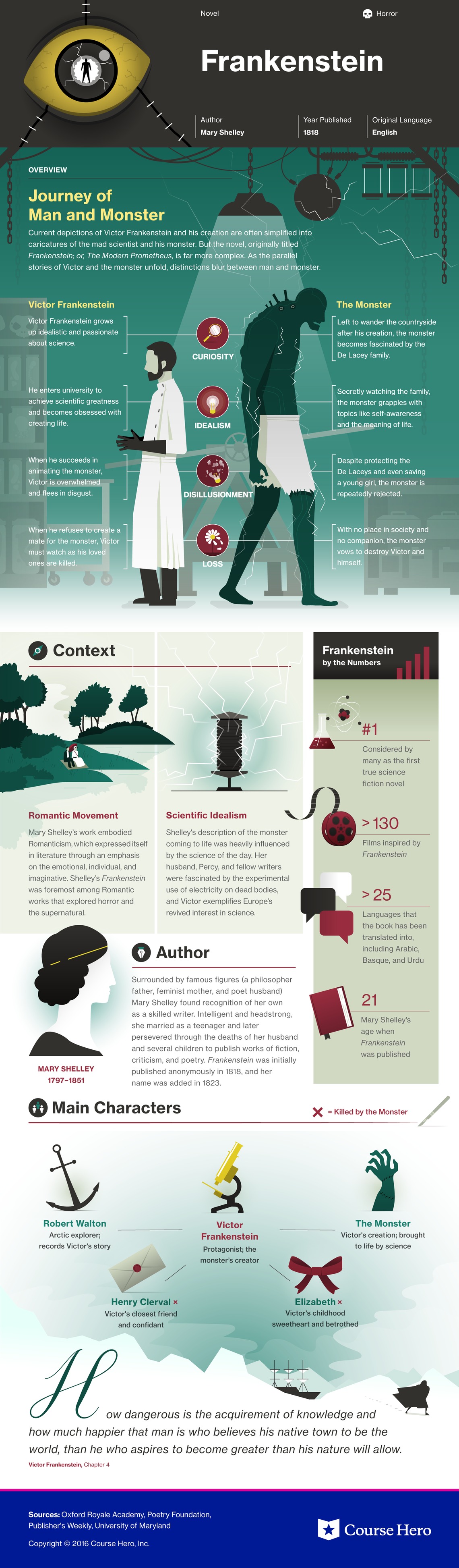
"Frankenstein; or, The Modern Prometheus" was completed in 1817 and published anonymously on January 1, 1818, in London. Mary Shelley’s name did not appear as the author until the second edition in 1823. The 1831 edition, which many modern readers know, was heavily revised by Shelley herself, providing further context for the story’s origin and intent.
Historical Context:
The novel was written during a period of great scientific advancement and social upheaval. The aftermath of the Enlightenment, the Industrial Revolution, and the French Revolution shaped contemporary debates about science, human nature, and social progress. The rise of secular ideologies, advancements in biology (such as Luigi Galvani’s experiments with electricity), and anxieties about unchecked ambition deeply influenced Shelley’s themes.
Personal Context:
Mary Shelley was just 18 when she began the novel, during a summer at Lake Geneva with her future husband Percy Bysshe Shelley, Lord Byron, John Polidori, and Claire Clairmont. A ghost-story competition among the group and a waking nightmare inspired by discussions of galvanism and the spark of life prompted Shelley’s vision of a scientist overreaching the limits of nature.
Genre & Fictional Mode:
- Gothic Fiction: Elements of horror, the sublime, isolation, and transgression.
- Science Fiction Prototype: Often called the first modern science-fiction novel because it speculates on creating life through scientific means rather than magic.
- Epistolary/Frame Narrative: Told through letters and nested stories (Captain Walton → Victor Frankenstein → the Creature).
- Philosophical Novel: Explores ethical, moral, and metaphysical questions about science, creation, and responsibility.
Plot Overview of Frankenstein:

Mary Shelley’s Frankenstein; or, The Modern Prometheus (1818) is framed through a series of letters written by explorer Robert Walton to his sister in England. Walton is on a polar expedition, driven by a thirst for discovery. Amid the ice, he rescues a half-frozen man: Victor Frankenstein, who begins to recount the tragic story that brought him to the Arctic wastes.
Victor’s Youth and Ambition:
Victor, born to a wealthy Geneva family, grows up with a strong interest in science and philosophy. Inspired by old alchemists yet guided by Enlightenment science, he studies at Ingolstadt University, where his obsession with the secrets of life intensifies. Convinced that he can discover the source of vitality, he throws himself into experiments in anatomy and chemistry. Eventually, he masters the power to reanimate dead matter, dreaming of creating a new, better race of beings.
The Creation and Abandonment:
Victor constructs a giant being from assembled corpses. But the moment the Creature stirs to life, Victor is overcome with horror and revulsion at what he has made. Instead of embracing his creation, he flees, leaving the newborn being to fend for itself. This rejection plants the seeds of tragedy.
The Creature’s Struggle for Acceptance:
Alone and bewildered, the Creature wanders the world, learning about human society from afar. He secretly observes a poor rural family the De Laceys and teaches himself language and moral principles by watching them and reading books he finds, including Paradise Lost. Through these lessons, he develops sensitivity, compassion, and a yearning for companionship. However, when he finally reveals himself to the family, they recoil in fear, driving him away. Everywhere he goes, humans treat him with hostility and violence because of his monstrous appearance.
Demand for a Companion:
Bitter from rejection and emboldened by anger, the Creature confronts Victor, demanding that he create a female companion who might understand and love him. Initially, Victor agrees, haunted by guilt, and begins the work. But halfway through, he destroys the unfinished mate, fearing they might breed and propagate a new, dangerous race.
The Cycle of Revenge:
Enraged at this betrayal, the Creature vows vengeance. He begins killing those dear to Victor: first the young child William, then Victor’s best friend Henry Clerval, and finally his bride Elizabeth, murdered on their wedding night. Each loss plunges Victor deeper into grief and obsession, until his life becomes consumed by the pursuit of his enemy.
Pursuit to the Arctic:
Victor chases the Creature across Europe and into the frozen Arctic, determined to destroy him. It is in this pursuit that Walton finds Victor, broken and near death, recounting the saga as a warning against unchecked ambition and the dangers of playing god.
Ending:
Victor dies aboard Walton’s ship, urging the explorer not to sacrifice his crew’s lives in pursuit of glory. After his death, the Creature appears in Victor’s cabin, filled with sorrow. He tells Walton that he never wished for such misery but became a fiend because of loneliness and rejection. Declaring that he will end his suffering and guilt by taking his own life, the Creature disappears into the darkness of the Arctic, vowing to build a funeral pyre and burn himself to ashes.
Characters:
Major Themes:

- Ambition & Overreaching Science: The dangers of unchecked pursuit of knowledge without ethical responsibility.
- Creation & Parenthood: Responsibilities of creators toward their creations.
- Isolation & Alienation: Both Victor and the Creature suffer from social and emotional isolation.
- Nature vs. Nurture: The Creature’s behavior reflects how environment and rejection shape identity.
- The Sublime & Nature’s Power: Nature as both healing and destructive.
- Justice & Injustice: The execution of Justine highlights flaws in human institutions.
Legacy:
Mary Shelley’s Frankenstein is widely regarded as the first true science-fiction novel, inspiring authors like H.G. Wells, Jules Verne, and many modern sci-fi writers. Over the years, “Frankenstein” has become a cultural shorthand for reckless scientific ambition and unnatural experiments, while the Creature itself has grown into an enduring icon through adaptations such as James Whale’s 1931 film and countless later retellings on stage, screen, and television. At the same time, the novel continues to resonate in serious ethical debates, frequently cited in discussions of cloning, artificial intelligence, genetic engineering, and bioethics. In academic circles, it remains a rich text, explored through feminist, psychoanalytic, and postcolonial interpretations, reflecting its layered engagement with themes of creation, responsibility, and human ambition.

- Title: Mary Shelley’s Frankenstein
- Release Year: 1994
- Genre: Gothic horror / science-fiction drama
- Director: Kenneth Branagh
Questions:
Que. 1| What are some major differences between the movie and the novel Frankenstein?
Ans.

Introduction:
Mary Shelley’s Frankenstein; or, The Modern Prometheus (1818) is often hailed as the first modern science-fiction novel. Nearly two centuries later, director Kenneth Branagh attempted to bring the story to life in Mary Shelley’s Frankenstein (1994), starring himself as Victor and Robert De Niro as the Creature. The film promoted itself as a “faithful adaptation,” but, like almost every cinematic version, it reshapes key characters, events, and themes. Below is an in-depth look at how the two versions diverge.
1. The Act of Creation:
In the novel, Mary Shelley keeps the act of animating the Creature vague and off-stage. Victor Frankenstein collects body parts and uses “instruments of life,” but the technical process is never revealed; the focus is on his ambition and the aftermath of success. This ambiguity leaves readers to imagine the horror for themselves.
The film turns the laboratory scene into an operatic spectacle. Branagh shows Victor wiring together body parts, using electrical eels, hydraulic pumps, and amniotic fluids, and physically wrestling with the apparatus as thunder crashes. This makes the creation of life a vivid cinematic moment and a centrepiece of the film rather than a shadowy suggestion.
2. How the Creature Looks:
Shelley’s Creature is hideous but also proportionate, with yellowish skin, black lips, and lustrous black hair a disturbing yet almost sublime figure.
Branagh’s Creature, played by Robert De Niro, resembles a brutally scarred corpse. His patchwork face and shaved head stress surgical realism rather than the eerie elegance of the novel. This change pushes the film closer to body-horror than to Gothic sublimity.
3. The Creature’s Education:
One of the most moving sections of the novel is the Creature’s secret observation of the De Lacey family. Over many months he learns language, history, and moral concepts from their conversations and from books like Paradise Lost. When he finally approaches them, their rejection shatters him and sets his revenge in motion.
The film compresses this period drastically. The Creature does meet the De Laceys, but we see only brief hints of his self-education. As a result, his intellectual and moral growth feels much faster and less detailed, reducing the philosophical weight of his tragedy.
4. Elizabeth’s Fate:
In Shelley’s story, Elizabeth Lavenza marries Victor but is murdered by the Creature on their wedding night. Her death is final and becomes the catalyst for Victor’s final pursuit.
The film radically rewrites this. After Elizabeth is killed, Victor actually tries to resurrect her by transplanting her head onto another woman’s body. The reanimated Elizabeth is a tormented hybrid who ultimately sets herself on fire. This new subplot adds a spectacular Gothic horror scene and underscores Victor’s obsession with defying death, but it is absent from the novel.
5. Victor’s Personality:
In the novel, Victor is introspective, guilt-ridden, and often bedridden with illness. He is a man undone by ambition, not a heroic action figure.
In the film, Branagh plays Victor as passionate and physically active rushing around his lab, leaping into icy water, and trying to control events. This makes him more of a Romantic hero-scientist than the fragile, brooding scholar of Shelley’s pages.
6. Timeline and Deaths:
Shelley carefully paces the deaths William, then Justine’s wrongful execution, then Henry Clerval, then Elizabeth. This slow escalation gives weight to Victor’s guilt and the Creature’s vengeance.
The movie compresses and rearranges these events for cinematic flow. Some characters die differently, and some scenes are combined. This keeps the narrative moving on screen but alters the emotional rhythm of the original story.
7. The Ending:
Both novel and film end in the Arctic, but with key differences. In the book, Victor dies aboard Walton’s ship, and the Creature appears to mourn him before disappearing into the ice to end its own life. Shelley leaves the Creature’s fate ambiguous.
In the film, the Creature builds a funeral pyre, places Victor’s body upon it, and burns with him in an explicit act of self-immolation. This more visual, definitive ending provides catharsis for viewers but closes off the open-ended mystery of the novel.
8. Tone and Themes:
Shelley’s novel is a slow, layered meditation on scientific ambition, moral responsibility, alienation, and the shaping power of environment versus nature. Much of its horror is psychological and ethical rather than graphic.
Branagh’s film retains these themes but infuses them with high-intensity Gothic spectacle blood, lightning, and grand gestures. Some critics praised the film’s faithfulness to plot, but others felt the operatic tone overshadowed the subtle moral and philosophical questions that give the novel its depth.
Conclusion: Two Different Creatures:
Kenneth Branagh’s Mary Shelley’s Frankenstein is one of the most faithful big-budget adaptations of the novel, yet it inevitably reshapes the story to fit cinema’s need for spectacle and pacing. By amplifying Victor’s passion, compressing the Creature’s education, and adding the resurrection of Elizabeth, the film moves away from Mary Shelley’s introspective Gothic meditation and toward a vivid, tragic horror drama. Both versions, however, explore the same timeless questions: what happens when human beings push science beyond its ethical limits, and what responsibilities do creators owe to their creations?
2) Who do you think is a real monster?
Ans:

In Frankenstein by Mary Shelley, we can find that the question who is the real monster in Frankenstein? The answer is too complex. the following points give the answer of this question:
Who Is the Real Monster in Mary Shelley’s Frankenstein?:
Since its first publication in 1818, Frankenstein; or, The Modern Prometheus has provoked a single, haunting question: who is the real “monster” of the story? The grotesque Creature assembled by Victor Frankenstein? Or the scientist who brought him to life and then abandoned him? Mary Shelley wrote her novel during a time of rapid scientific change and Romantic reflection, and she deliberately framed the narrative to keep the answer ambiguous. Looking closely at both figures reveals how the book redefines monstrosity as more than just physical appearance.
Victor Frankenstein: Ambition Without Responsibility:
Victor is a gifted, idealistic young man, fascinated by natural philosophy and determined to unlock the “secrets of heaven and earth.” His ambition drives him to collect body parts in secret and, through untested experiments, animate a new being. Yet the instant his creation opens its eyes, Victor recoils in horror and flees. He offers no guidance, care or even acknowledgment of the Creature as a living being. This abdication of responsibility sets off a chain reaction of suffering: William’s murder, Justine’s wrongful execution, the deaths of Clerval and Elizabeth. Even as these tragedies unfold, Victor hides the truth and focuses on revenge rather than confession or reconciliation. His hubris, secrecy and moral cowardice traits often associated with “villains” in Gothic literature mark him as monstrous in spirit even if he looks like a respectable scientist.
The Creature: From Innocence to Vengeance:
By contrast, Shelley depicts the Creature as a tabula rasa at first strong and strange, but sensitive, curious and eager to learn. Alone in the wilderness, he struggles to survive, feels the warmth of the sun, and teaches himself to speak and read by observing the De Lacey family. He reads Paradise Lost and identifies with both Adam and Satan. All he wants is acceptance, affection and a place in the human community. It is only after repeated rejection culminating in being beaten and driven away by the very family he admires that he turns to vengeance. His crimes are terrible, but they spring from pain, despair and abandonment rather than innate evil. Shelley gives him eloquent speeches and deep self-awareness, making it hard for readers to dismiss him as a simple villain.
Appearance Versus Morality:
A central irony of the novel is that the “monster” looks monstrous but begins as compassionate, while the “human” creator appears respectable but acts irresponsibly. Shelley thus subverts a long Gothic tradition of equating deformity with moral corruption. She forces readers to ask: is monstrosity defined by physical form, by behaviour, or by a lack of empathy? The answer is unsettling, because it shifts the label “monster” from the Creature to Victor and, by extension, to any society that judges by appearance or neglects its vulnerable.
Shared Responsibility and the Real “Monster”:
Shelley does not present either character as purely innocent. Victor’s hubris and neglect create the conditions for tragedy; the Creature’s retaliatory murders perpetuate the cycle. The real “monster” may therefore be the combination of unchecked scientific ambition, social prejudice and moral irresponsibility a system, not just a person. By leaving the ending open and having the Creature mourn Victor, Shelley underscores that both are tragic figures locked in a destructive relationship.
Seen this way, the “monster” is not simply the Creature or Victor but the combination of unchecked scientific ambition, social prejudice and moral irresponsibility. Victor’s hubris and neglect create suffering, and the Creature’s acts of revenge perpetuate it. Shelley’s genius lies in leaving the answer open, forcing us to think about the ethical responsibilities of creators, parents, scientists and societies.
3) Do you think the search for knowledge is dangerous and destructive?
Ans:
Introduction:
The pursuit of knowledge in Mary Shelley's Frankenstein is depicted as profoundly dangerous and, ultimately, destructive. Shelley uses Victor Frankenstein’s story to warn readers about the perils of unchecked ambition and the desire to surpass human limitations.
Knowledge as a Double-Edged Sword:
Victor’s quest begins with noble intentions he wants to unlock the secrets of life and contribute meaningfully to science. However, his ambition soon becomes obsession. Shelley’s narrative demonstrates that knowledge in itself is not inherently evil, but when driven by unchecked ambition and a lack of ethical consideration, it leads to devastating consequences.
Victor’s creation of the creature represents humanity’s desire to “play God.” Instead of bringing life and enlightenment, Victor’s experiment unleashes misery and destruction, claiming the lives of his loved ones and causing Victor unbearable guilt and isolation.
Philosophical Reflections: Knowledge, Responsibility, and Hubris:
Shelley’s critique draws from Enlightenment philosophy, which values rational thought and the quest for scientific advancement. However, Frankenstein explores the dark side of this philosophy: when knowledge is sought without humility or ethical responsibility, it can corrupt and destroy.
Victor’s hubris leads him to see himself as above natural laws he disregards the consequences and abandons his creation, illustrating a failure in moral and social responsibility. This moral blindness is what ultimately leads to tragedy, not just for Victor but for everyone connected to him.
A key moment occurs when Victor warns Walton:
"Learn from me, if not by my precepts, at least by my example, how dangerous is the acquirement of knowledge, and how much happier that man is who believes his native town to be the world, than he who aspires to become greater than his nature will allow."
This serves as Shelley’s cautionary message that the pursuit of knowledge, when driven by ego and without foresight, can bring about ruin rather than progress
The Destructive Reach of Ambition:
The novel presents the destructive effects of knowledge through several characters:
Victor, who loses his health, sanity, and loved ones.
Walton, whose own ambition mirrors Victor’s path, highlighting the universal risk.
The creature, whose own attempts at understanding humanity lead him to suffering and vengeance.
The Arctic setting symbolizes the cold isolation and barrenness that can result from unbridled intellectual pursuit. Shelley warns readers that while curiosity is fundamentally human, knowledge must be tempered with ethical consideration, humility, and responsibility.
Conclusion:
Shelley’s Frankenstein argues that the search for knowledge can be both inspiring and perilous. When ambition overshadows wisdom and ethics, knowledge becomes a source of suffering and destruction. The true danger lies not in knowledge itself, but in its reckless pursuit without regard for consequences making this lesson as relevant today as it was in Shelley’s Time.
4) Do you think Victor Frankenstein's creature was inherently evil, or did society's rejection and mistreatment turn him into a monster?
Ans:
Introduction:
Victor Frankenstein's creature is not inherently evil; rather, Mary Shelley's novel shows in detail how society's rejection and mistreatment turn him into a "monster." The nature versus nurture debate is central to Frankenstein, with evidence strongly favoring the role of environmental factors especially the creature's neglect and isolation in shaping his tragic behavior.
The Creature’s Innocence and Potential:
Shelley depicts the creature as emerging into the world with an innocent, loving disposition and a desire for acceptance. Early in his existence, he demonstrates kindness, sensitivity, and a longing for human connection, observing the De Lacey family and learning language and empathy through them.
He expresses deep affection and even rescues a child from drowning, showing a capacity for goodness. The creature’s initial acts are gentle and well-intentioned, but they are met with violence and fear solely based on his appearance.
The Power of Nurture: Rejection and Abuse:
The turning point is his repeated rejection by humanity, beginning with Victor’s immediate horror and abandonment at his birth. Society responds to him with violence and screams, and even the De Laceys whom he admires and loves cast him out violently when he seeks acceptance.
The creature eloquently describes his transformation:
"I was benevolent and good; misery made me a fiend."
This statement foregrounds how persistent isolation, hatred, and lack of “nurture” warp his emotional life, fostering despair and driving him toward vengeance.
Shelley illustrates that the creature’s violence and rage are direct responses to emotional abuse and social exclusion. His tragic actions including murder are the consequences of cruel treatment, not inevitable outcomes of his nature.
Philosophical Argument: Society as the True Source of Monstrosity:
From a moral and philosophical viewpoint, Shelley critiques the way society labels the outsider as “other” and fails to provide compassion. The creature’s story becomes a powerful example of how monstrous behavior can be created not by birth, but by relentless neglect, prejudice, and scorn.
His story demonstrates that "monsters" are made when empathy is denied and difference is punished. The responsibility for the creature’s transformation into a monster thus lies primarily with Victor and the broader society, not with the creature’s construction or inherent nature.
Conclusion:
Shelley’s Frankenstein makes a strong case for nurture over nature. The creature is not born evil instead, it is the lack of kindness, belonging, and understanding that drives him to violence. This profound message resonates today, reminding readers of the moral consequences of exclusion and cruelty. The real "monster" is the result of society’s failure to show empathy to those who are different.
5) Should there be limits on scientific exploration? If so, what should those limits be?
Ans:
Introduction:
There should be limits on scientific exploration, and Frankenstein offers powerful arguments about what those limits ought to be. Shelley’s novel warns that ambitious science, when divorced from ethical responsibility and humility, risks tragic consequences for individuals and society.
Why Limits Are Needed:
- Victor Frankenstein becomes obsessed with unlocking the secrets of life, striving to transcend “accepted human limits” and treating science as a pursuit of personal glory.
- His lack of foresight about social and moral consequences leads to suffering for both himself and others, demonstrating that unchecked experimentation can be deeply harmful.
- Shelley’s narrative aligns with philosophical concerns about playing god and the ethical dangers of using science to override nature, reflecting the need for restraint and wisdom.
What Those Limits Should Be:
- Ethical oversight: Scientific research must be guided by ethics concern for well-being, consent, and prevention of harm. Researchers have a duty to consider the impact of their discoveries on individuals and communities.
- Accountability: Scientists must be accountable for their creations and actions. Responsibility doesn't end with a successful experiment; Victor’s tragedy was fueled by his abandonment of the creature rather than taking responsibility for its welfare.
- Respect for nature’s boundaries: Science should not seek to override or dominate nature purely for ambition or curiosity. Advancements need to be tempered by prudence and an understanding of potential unintended consequences.
- Social dialogue: Major scientific advances should involve public discussion, transparency, and input from diverse communities to ensure wider societal needs and values are respected.
- Caution with new technologies: Shelley’s cautionary tale remains relevant, particularly in areas like gene editing, cloning, and artificial intelligence, where the boundaries between progress and ethical risk are still debated today.
Conclusion:
Limits on scientific exploration are vital to prevent harm, maintain ethical standards, and ensure human dignity. Frankenstein remains a timeless warning: great discoveries must be matched with caution, compassion, and accountability, lest ambition lead to unintended consequences and suffering.
Words: 4071
Images: 7
Videos: 1
Links: 2
References:
1. Britannica, The Editors of Encyclopaedia Britannica. “Frankenstein; or, The Modern Prometheus” Encyclopedia Britannica,
https://www.britannica.com/topic/Frankenstein-or-The-Modern-Prometheus
2. Differences between Mary Shelley's novel Frankenstein and the 1994 film adaptation, eNotes.
Thank you!


.png)

No comments:
Post a Comment